Monday, August 31, 2009

Killing Time


Bed rest is far less satisfying than it sounds. Though I'm constantly resting, the fact that I need to stay in bed is not comforting, and therefore it is difficult to relax. In my former life, I wished for a year where I could lie around and do nothing. Be careful what you wish for, right?

The condemning factor in bed rest is that there's not very much one can do while lying flat on the back. Reading, sewing, yo-yos, cards, board games, drawing, and a host of other activities are out, and I don't nap. I suppose that if I had felt a passion for drawing, I could have found a way, but holding a pad straight in the air doesn't sound like the most enjoyable pastime. Writing (via typing) eats up some hours, but holding up the arms to type has proven difficult, so I write in small occasional spurts. Thus, I'm left with movies and TV, which, while entertaining, are extraordinarily uninteresting after a year. I think it was once I started watching "Beverly Hills 90210" that I realized I was in over my head.

Many people reference the movie "Frida" when they hear about my predicament, and I have to remind them that during her years of bed rest, Frida Kahlo was sitting straight up, which allowed her to paint fairly easily.

Also, she was one of the greatest painters of the twentieth century, so she might have had a bit more drive to paint than I.

photo credit: http://blogs.wcuquad.com/wp-content/uploads/2009/05/relax.jpg

Wednesday, August 26, 2009

Surgical Trauma

Surgery is the back patient's last resort. Doctors say that an operation is necessary if you can't live with your pain level any longer, or if it is preventing you from living your life. What they don't tell you is that, sometimes, surgery doesn't change that.

I picked a microdiscetcomy because I had been limping straight for eight months. I was housebound, worried about taking too much time off and losing my health insurance when my status changed from "full-time student" to "medical leave". And I thought that keeping one part of my spine compromised would damage another part, causing a chain reaction that would leave me a cripple.

Yes, I tend towards the melodramatic. But I also believed I had waited long enough for something to work.

My surgeon told me that a successful surgery would result in a disappearance of sciatica from my right leg. However a week post-op, as I weaned myself off Vicodin, sciatica appeared in my left leg. I immediately drew all sorts of fatalistic conclusions, which were generally scoffed at as hysterical. Nine months and three cortisone injections later, both my legs are sciatic, and my surgeons are baffled.

Yesterday I rode a stationary bike next to a girl my age. She has a bulging disc, and is contemplating surgery. After our conversation, I thought more critically about what I had said, and I wished I had voiced a more forceful opposition to an operation. I should have said that one's lowest points are relative to what could happen down the road - and that the phrase "the last resort" really means the last thing you should ever try.

photo credit: http://www.surgery.wustl.edu/uploadedImages/Surgery/Surgical_Areas/mis_08_laparoscopic-surgery.jpg

Thursday, August 20, 2009

Fright

I rode a reclining bicycle for ten minutes today.

My PT is pushing me a bit lately. That's good, because I'm building strength and confidence, but I still have a residual, radiating fear of movement. My prior PT worked within a philosophy that included locking the spine in a neutral position, and while this is effective in the short term - particularly after surgical trauma - it has become ingrained in my muscles and mind, preventing me from recovering fully.

My former personality was such that I threw myself into things passionately and deliberately. However, having spent a year literally holding myself together, I approach life with an entirely new attitude that includes both ergonomic precision and tight fear. The latter is something I don't understand, because it is an emotion I have never let in. Now, though, I doubt myself. It is a difficult instinct to overcome.

But, today I rode a reclined bicycle for ten minutes. Cool.

photo credit: http://www.thedeafblog.co.uk/Bionic%20eye.jpg

Tuesday, August 18, 2009

A Tail of Sport

At ten years old, I attended my first basketball practice. My mother forced me to go, an action I don't think she regrets but one that definitely shaped our lives. I wore white Keds, which work well while dancing in parade routines but not so much when running on shiny gym floors. Despite that, I still challenged myself to outrun every other girl there. I succeeded.

I played basketball for the next eight seasons, eventually becoming a center and using my dance training to become the team rebounder (cause that involves a lot of jumping, you non-sport-inclined folks out there). Playing in the post requires either a large, tall body to push people out of the way and grab missed shots or a truckload of perseverance and major hops (that is, an ability to jump). Large people will throw their smaller opponents to the ground in the quest for rebound greatness - which brings me back around to my spine.

When one falls on the bum, the last bone in the spine will feel most of the impact. That is the coccyx, better known as the tailbone. It is the last remnants of a tail shrunk by evolution. The trauma of a fall is absorbed by the coccyx, causing it to bend upward into the pelvic floor (a group of muscles at the bottom of the pelvis). The coccyx is a tiny bone, particularly relative to the sacrum and lumbar vertebrae. It is possibly the size of the index finger, if that. Yet repeated trauma and pressure on the coccyx can cause it to bend in any direction and get stuck there, like a wagging tail stuck in glue. That in turn pulls the lumbar-sacral region, causing nerve pain and/or strain on the vertebrae and discs.

The sheer number of times I have fallen on my butt when I was playing ball is daunting now in retrospect. I always bounced right back into the game, but adrenaline is a powerful drug, and among its many abilities is to function as a transitory painkiller. My osteopaths find my tailbone intriguing - and classic - because I haven't fallen since my senior year in high school and yet here I am with a displaced coccyx and crazy lower back problems.

The coccyx is a rather insignificant bone, but it is common knowledge that the spine functions as an entity rather than as individual parts. My history clearly shows that I was an active person with potential for mild exercise trauma, which in cumulative form could become injurious.

My question is, why on earth did my spine surgeons not check for this? It seems logical to me that before cutting into someone's spine - which would seem the second-least understood part of the body, after the brain - you should check the health of the entire thing to make sure everything is a-okay.

But that's just me. In the meantime, I can relive my glory days in the uniform, and wonder why I thought all my aches and pains were completely benign. Maybe it's because I was seventeen years old - or maybe it's because the only evidence of trauma was hidden in my two-inch long reminder of a tail.

photo credit: http://graphics8.nytimes.com/images/2007/08/01/health/adam/19464.jpg

Saturday, August 15, 2009

Gait Training


The days are getting shorter.

Bed rest has caused me to really notice the lengthening and shortening of the days. For the first time ever, I associate solstices and time changes with emotions rather than notes on my calendar.

Post-op, my physical therapist assigned me to take three walks each day, starting at 15 minutes and working my way up. Over time, I've arrived at 35 minutes per walk. It's tough to get three walks in each day - to space them far enough apart so that I'm not injured, but close enough that the light doesn't run out on me. During the winter, I could never fit in three walks by sunset. I spent every night walking the streets, looking forward to spring so that I could walk without four layers and a flashlight.

I walk religiously, and meticulously. Early on my PT declared my gait was totally wrong, and we spent the better part of February and March perfecting it. I graduated from my stiff, lumbar-pulling march to a glut-powered stride that is both ergonomically correct and energy efficient. Changing my gait eliminated all hip pain and a significant amount of sciatica, and I thus I am extremely proud of it. I also use it as evidence that sometimes the little things add up.

Walking is oddly liberating, and I think I took it for granted before surgery (meaning, all my life). I used to find walks and hikes decidedly boring, but now that my strolls are essentially choreographed, it seems easier. I may even go so far as to say that my walks are the highlights of my day.

However, I will not mourn their loss when I reclaim running as my chief form of exercise.

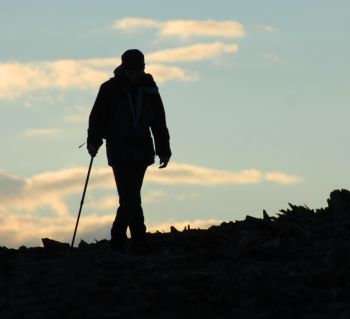
photo credit: http://www.biosphere-expeditions.org/images/stories/tasters/walk.jpg

Tuesday, August 11, 2009

Sciatic Pain

sciatica: pain along the course of a sciatic nerve especially in the back of the thigh; broadly, pain in the lower back, buttocks, hips, or adjacent parts.
(source: Merriam Webster Online Dictionary)

Now, to a more exact and helpful description...

Sciatica is an indescribable symptom. It is so variant and so painful that when you go to a doctor's office, they have to use a list of sensations used to describe it that is 10+ words long, none of which actually describe what you are feeling. Words like "burning", "shooting", "aching", and "stinging" all carry a specific connotation which can only describe part of what is felt. I have found that phrases like "as if an electric wire that is running down the back of my leg suddenly went haywire" work better.

So if your doctor asks you to describe exactly your sciatica feels like, remember that it feels different to every person. You could try to summarize the pain with the words provided on your intake form, or, if you are feeling particularly annoyed with the length of time you spent sitting in their painful waiting room chairs, just pinch the back of the doctor's thigh as hard as you can. Then say, "It feels like that."

photo credit: http://www.therapads.com/images/back1.jpg

Friday, August 7, 2009

Contact Points

My father hates chiropractors, so I never thought I would end up in one's office. Since my childhood I've heard nothing but tales of woe detailing crippled health nuts, tortured into certain chair rest by a psychopathic manipulator. But a few weeks ago we were contacted by an old pal of my parents who has a spine history similar to mine. He recommended a chiropractor friend of his who practices Network Spinal Analysis, a technique centered around increasing spinal cord flexibility. The theory is that if a disc is bulging or herniated, the spinal cord would have room to move around the bump. This would then result in less nerve pain. I'm a big fan of flexibility in general, and the treatment is supposed to be super gentle and painless. So I was all for a soiree into uncharted waters.

This is my first move into seriously "alternative" treatments. Far from being accepted by HMOs and surgeons, NSA (yup...) is so obscure that the doctors at UCSF's Integrative Medicine Center haven't even heard of this thing. Up until now, everything I've done has been generally accepted by free-thinking medical practitioners.

(It should be noted that I live in an ex-hippie settlement of a city, so perhaps things like osteopathy and psychoanalysis are less obscure here than in other areas. But I've generally resisted ideas that are far "out there" (pun intended).)

Perhaps that wasn't such a bad policy.

The treatment itself wasn't that exciting - it essentially involved her pressuring certain "contact points" to stretch the spinal cord. It felt like I was in middle school being poked by individuals who think they're funny. I felt unusually relaxed, though - atypical of my middle school experiences.

However, it was afterwards that the cracks really started to show. It was almost like a facade broke down on the woman. She started having oddly timed laughing fits, and qualifying her faith in the treatment, and making hyperbolic conclusions about my personality and physical problems despite having known me a total of 45 minutes. It confused me, because I was completely on board with the treatment plan until she went around the bend. I stared at her thinking, "Wow, lady. What are you on?"

She told me stories about "normal" NSA clinics, where up to 100 people are treated at a time. A doctor roams between patients, poking them for a bit, then moving on and letting their bodies absorb the stimulation of the "contact points." Apparently, NSA can release unknown emotion tensions, and in a group setting psych experiences are had en masse. "I know, it's really trippy and weird, huh! It totally works though. But I bet you think it's weird. I do."

Um. What??

As I left, she said, "If you come back, I'll be really surprised!" Like it was a joke.

Excuse me. If you are going to mess with my severely malfunctioning spine, I want you to have complete confidence that what you do is awesome and will help me. Period.

I am torn now, because I am on board with her Plan but I am not on board with her. If I were to take my own advice, I always tell people that if you don't trust a doctor, you should find a new one. But it's really awkward now since she practically dared me not to come back. I mean, how do I respond to that? Seriously.

Conclusions: Network Spinal Analysis might yield some benefits. Dr. Trippy, however, scares me. I will not be returning.

photo credit: https://www.positivehealth.com/images-original/dbimg/thomas112.jpg

Thursday, August 6, 2009

Confessions of an Invalid

I'm twenty years old and I've been on bed rest for the past nine months.


My back pain started when I was seventeen, and it has progressed through a dull ache to raging sciatica and everything in between. I pushed through the pain for three years, telling myself that a teenager doesn't have serious back problems. Later, I faced a plethora of doctors and a definitive MRI and slowly woke up to reality. When I could no longer live with my burning leg, I went under the knife for a simple surgery that promised a two-week recovery and a six-week hiatus on my daily runs. However my body had other plans.

I'm at a crossroads now, because Western medicine has nothing left to offer me save more radical, more painful surgeries. I'm not interested in spinal fusions, so I am turning to the unknown and the unaccepted. I will document my experiences here for posterity's sake, and so that, maybe, someone out there will find knowledge that can help them.

I always wanted someone who could relate to what I am going through, a younger person who's body failed them as mine did me. I wanted to hear opinions on treatments and learn new ways to kill time, hear survival stories and know that there is hope. That's why I'm writing a blog. Some of this will be reports on current treatments; some will be memories of my convalescence; some will be revelations and tidbits and stories about what I do all day as my body debates whether I've done enough to start living again. I hope that all of it is interesting and informative, and if I'm lucky (and not too conceited), inspiring.

If you're out there, don't lose hope. If someone can recover from cancer to win the Tour de France, or swim the Olympics with a prosthetic leg, or surf with one arm, anything is possible.

The best of health to you, and me. These are Confessions of an Invalid.

photo credit: http://latinainstitute.files.wordpress.com/2008/11/hospital-bed1.jpg